

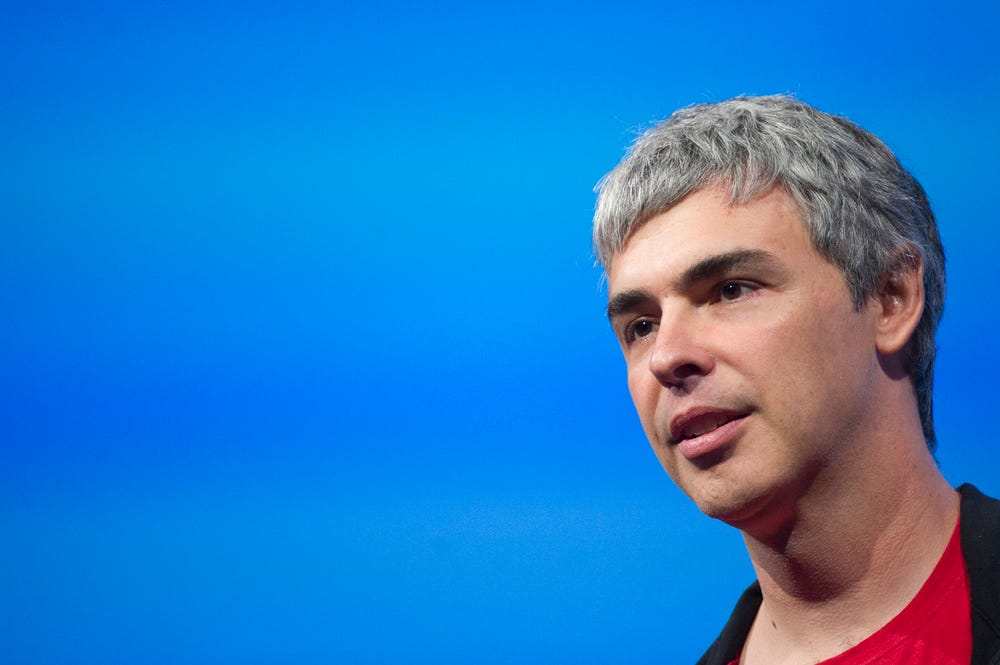
Larry Page has spent years quietly buying up Caribbean islands and erasing his footprint. Now, courts want to know where he is — and why the same LLC that bought the islands keeps appearing in unexpected places.
INVESTIGATION · JUNE 2026 · 6 MIN READ
| $32M
Paid for Cayo Norte alone — one of 5+ islands Page owns |
4+
Times US Virgin Islands attempted to serve Page a subpoena |
$520B
Combined net worth of Page and Brin as of late 2025 |
There is a version of Larry Page that the world knows well: the Stanford PhD student who sketched out a search engine on a whiteboard, co-founded Google in a Menlo Park garage, and helped build one of the most valuable companies in human history. Then there is the Larry Page who has spent the better part of a decade methodically disappearing — and whose paper trail keeps surfacing in courts, property records, and legal filings he seemingly wants no one to find.
The latest chapter involves a Caribbean property empire, a series of shell companies, and a federal lawsuit that has had considerable difficulty simply locating the man at its center.
An archipelago built in silence
Page’s island acquisitions did not happen overnight. The portfolio was assembled transaction by transaction, each routed through limited liability companies that obscure ownership until investigators dig through deed records. In 2014, he acquired the Hans Lollik Islands — a pair of privately held islands in the U.S. Virgin Islands — for approximately $23 million. A few years later, Eustatia Island in the British Virgin Islands followed. In 2018, the same LLC used for prior purchases — a company called U.S. Virgin Island Properties, identified by Business Insider as belonging to Page and his wife, Lucinda Southworth — completed the acquisition of Cayo Norte, a 1,000-acre island sitting between Puerto Rico and the British Virgin Islands, for $32 million across two transactions.
By 2020, Page had crossed into the South Pacific, purchasing a majority share in the Fijian island of Tavarua. When the pandemic shuttered Fiji to most travelers, Page reportedly spent months on the island, entering the country by private jet at a time most of the world was grounded.
“A billionaire with five private islands, no fixed address, and a subpoena he couldn’t be handed.”
The lawsuit that couldn’t find its witness
The legal complications began in earnest in 2023. The government of the U.S. Virgin Islands, pursuing a civil lawsuit against JPMorgan Chase over the bank’s alleged facilitation of Jeffrey Epstein’s sex trafficking operation, sought to subpoena Page as a witness. Prosecutors described him in court filings as a high-net-worth individual whom Epstein “may have referred or attempted to refer to JPMorgan.” Page has not been accused of any wrongdoing.
What followed was, by the standards of federal legal proceedings, almost farcical. The Virgin Islands government hired a private investigative firm to locate Page. The firm identified four possible addresses. A process server visited each one. None were valid. The territory subsequently asked the court for permission to serve Page by alternative means — including via Alphabet’s corporate offices, given that he remains a board member — after good-faith physical attempts produced nothing.
The episode crystallized something that observers of Page’s post-Google life had noted for years: this is a man who has deliberately engineered his own unlocatability, even as his name appears on deeds, LLC registrations, and corporate filings across multiple jurisdictions.
The California exit and the LLC shuffle
The geographic distancing accelerated further in December 2025. Page and fellow Google co-founder Sergey Brin — whose combined net worth stood at roughly $520 billion — terminated or relocated sixty limited liability companies previously registered in California. The companies, which hold significant portions of their personal assets, were quietly moved out of state. No public explanation was offered. None was legally required.
The timing was notable. California has some of the most aggressive tax and disclosure rules for high-net-worth residents in the United States. Both Page and Brin had already reduced their California ties considerably. The LLC restructuring was another rung down the ladder of legal detachment from any single jurisdiction that might claim jurisdiction over them or their assets.
“Page and Brin moved 60 LLCs out of California in a single month. No announcement. No explanation. None required.”
What the islands actually represent
Private island ownership among the ultra-wealthy is not unusual. Richard Branson has long operated from Necker Island in the British Virgin Islands. Other billionaires maintain similar retreats. What distinguishes Page’s archipelago is the scale, the deliberateness of the acquisition strategy, and the way each island was purchased through structures that make ownership difficult to trace without deep investigative work.
Together, the islands form something closer to a parallel jurisdiction than a vacation portfolio. They offer physical distance from courts, cameras, and the ordinary apparatus of accountability that governs even the very rich. In a world where a sitting federal court cannot determine a man’s mailing address, those properties are not merely real estate. They are infrastructure.
Receding from view, retaining control
Page stepped down as CEO of Alphabet in 2019. He has given no major press interviews since. He does not maintain a public social media presence. He travels by private jet and superyacht. He owns more documented private landmass than many small municipalities. And yet, through a special class of voting stock he and Brin retain, he continues to exercise effective control over a company worth more than $2 trillion.
That combination — total institutional power, zero public presence — is the defining feature of Page’s current existence. The lawsuit, the islands, the LLC exodus: they are all expressions of the same underlying project. Not retirement. Not eccentricity. Something more deliberate than either.
The most powerful private citizen in the history of the internet has made himself, for all practical purposes, unreachable. Courts are still catching up.